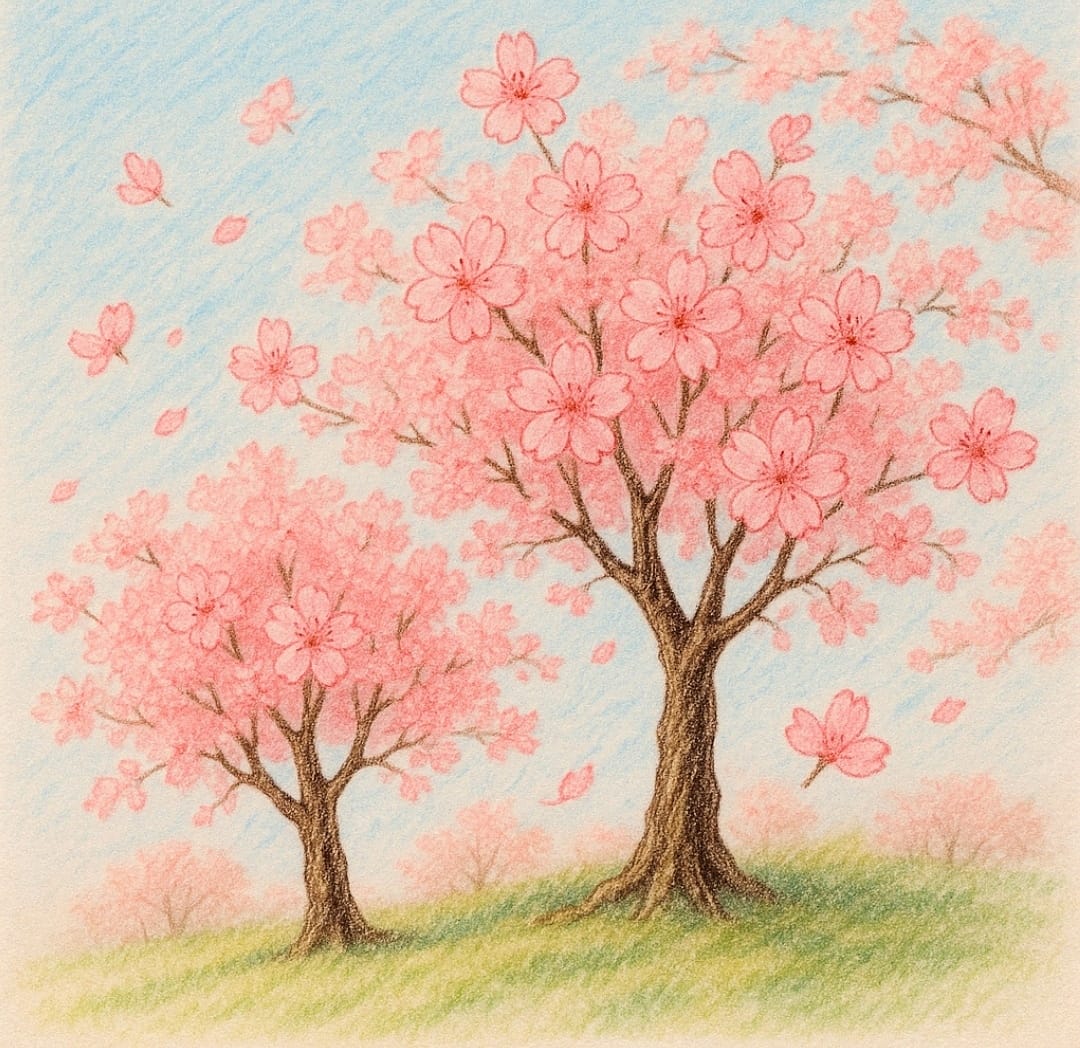
de Denisa-Andreea Pătrăsciuc, clasa a X-a B
Sursă imagine: creație personală – Denisa-Andreea Pătrăsciuc
Every spring, Japan becomes the stage for a fascinating natural spectacle: the blooming of the cherry trees, known as sakura. This phenomenon is not just a simple floral event, but a true cultural celebration that reflects the Japanese people’s sensitivity towards nature, time and transience.
In spring, when the cherry trees bloom, the entire country of Japan enters a state of contemplation and celebration. For several days, people gather in parks to take part in „Hanami”, the tradition of admiring the flowers. This practice is not only an opportunity to socialize, but also a moment of reflection on the passage of time. The cherry blossoms, delicate and short-lived, remind us that nothing is eternal and that true beauty often lies in fleeting moments.
In Japanese culture, sakura is associated with concepts such as „mono no aware”, a subtle feeling of melancholy linked to the ephemeral nature of things. The rapid blooming and equally swift falling of the petals express the idea that life is beautiful precisely because it is short.
Moreover, cherry blossoms symbolize hope at the beginning of a new cycle. In Japan, both the academic and the financial year begin in April alongside the burst of flowers, marking a symbolic rebirth for both individuals and society as a whole.
The delicacy, grace and soft shades of the cherry blossoms have been admired since the 19th century so much so that they inspired artistic and literary movements – an influence reflected in the term „Japonisme”, the art of finding contentment.
Beyond its symbolic depth, the blooming of the cherry trees also has a major social and economic impact. Tourism flourishes during this period attracting millions of visitors from around the world.
All in all, the blooming of the Japanese cherry trees is more than just a beautiful sight. It is a moment of reflection, a reconnection with nature and a celebration of life in all its fragility and splendour. It is a time when Japan breathes in unison with the rhythm of nature, reminding us all how precious the present moment truly is.