Autor: Macsim Elena-Adriana, clasa a XI-a C
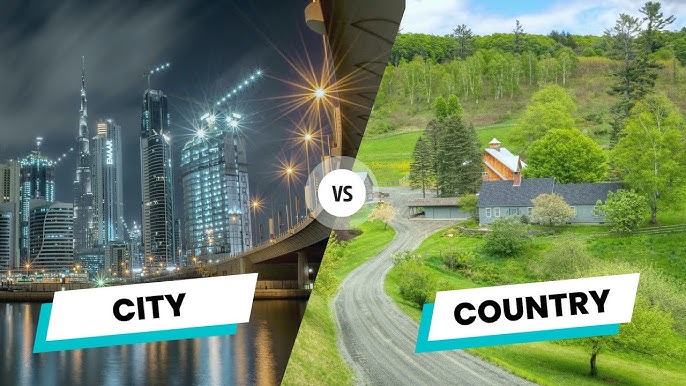
Sursă imagine: https://www.theprofessionalhobo.com/city-life-vs-country-life-an-unbiased-analysis/
It is a fact that, nowadays, many more people live in towns than in the country. Any many of us, however, long to live in the country because we think that life is better there. But most of us only visit the countryside during our free time and that is why we get an incomplete picture of what country life is really like.
To those living in towns, the country seems a place where we can get back to nature. There are fields and woods, birds and animals. There are no traffic jams and noisy lorries. The countryside is quiet and the way of life is slow. It seems idyllic. The air is clean, the water is pure and the food tastes better. To people in towns, the country seems to offer an escape from stress and strain. There is time to think about the important things in life, no mad rushing around after money and success.
Country dwellers might agree to most of these points but they would also say that life can be hard. If you have to work in the fields all day long, summer sun and winter snow do not seem so wonderful. Similarly, the quiet, which town people praise, can be empowering. There are many days when it seems as though there is nothing to do, nowhere to go. In the town if you are bored you can go to the cinema, to the theatre or to the mall. But these options are no longer available to country dwellers. Many farmers complain that they have no free time at all. They spend their whole lives working. They cannot go on holiday and even have to work when they are sick. Work in general is less well paid in the country. As a result, many people live the country for the city. And what do they find there? Noise, pollution, unemployment and stress. There is crime on the streets and people are rude. Little trace of nature remains. Every street is full of cars and everyone seems to be rushing about. Where are they going and what are they doing? No one knows.
Cities have been a major driving force in the development of civilization. The city, from the time of its earliest appearance, some ten thousand years ago, has focused and magnified human energies in the task of mastering the environment and reached our understanding by providing multiplicity of human contacts and provided the stimulus to the highest creativity in all form of science and art. It is at the same time responsible for many of the darkest features of civilizations – the spoliation of environment, the coercion of vast numbers of individuals by governments and economic exploiters, the exclusion of vast segments of the population from intellectual and social advancement, the segregation of many women in the private world of the household, separated both from the public world of political decision making and often from the productive world of economic activity.
In recent years, the process of urbanisation has been explored with considerable success by a wide range of social scientists. Their findings have thrown much light on such basic concerns as the impact of population growth, the special patterns of city development, the occupational structure of the city at various stages of development, class relationships, family structure, the functioning of political systems and the relationship to environment.
Throughout the development of civilization, most people have lived on the land and the city has always depended on the countryside for food and raw materials. So, if we look closely at town and country life, we see that neither is perfect. Whichever one you choose, there are going to be advantages and disadvantages.