Autor: prof. Bogdan Georgiana
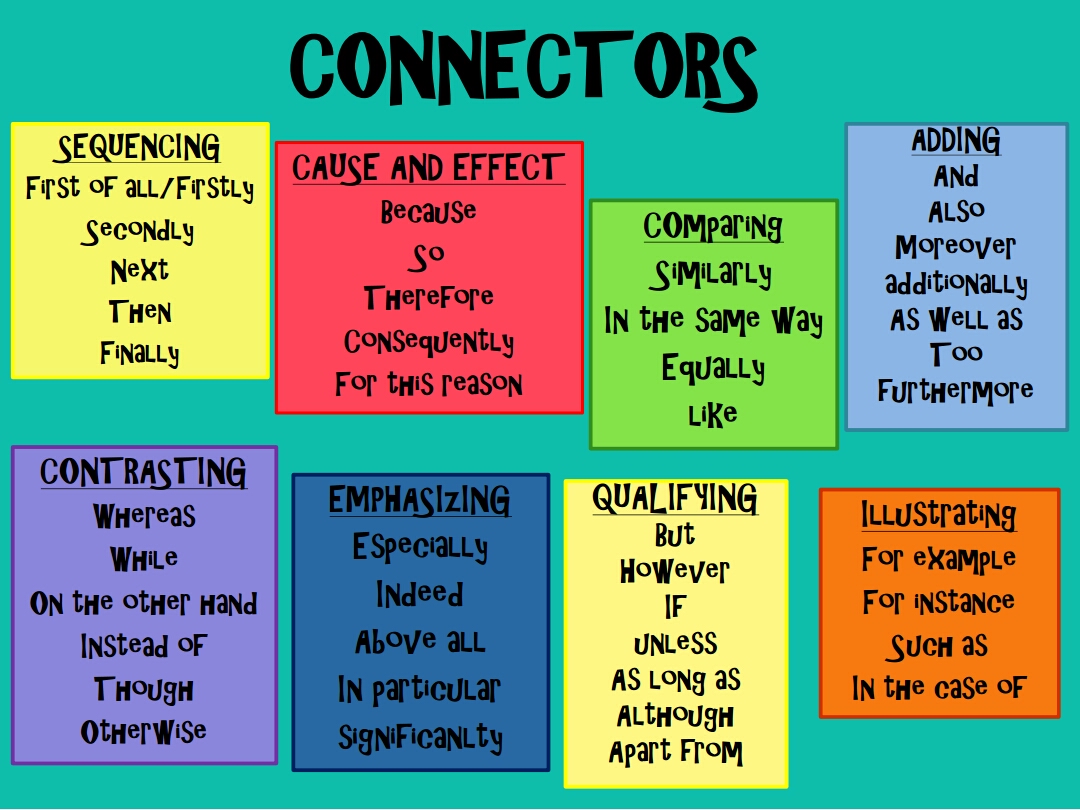
Sursă imagine: https://blocs.xtec.cat/ceipsantrocenglish/grammar/connectors/
Connectors are words such as ‘consequently’, ‘however’ and ‘so’ and phrases such as ‘in addition’, ‘in fact’ and ‘for example’ which are used to link clauses and sentences. (The Japanese economy has been very strong and consequently the yen has risen in value. In addition, the dollar has continued to show weakness. The pound, however, has remained steady.)
Focus structures are also used to link sentences. One type of focus structure is called fronting. In fronting, one part of a sentence ( I can’t eat asparagus) is moved to front position in order to focus attention on that part. ( I can eat broccoli and carrots. Asparagus I can’t eat.)
Another type of focus structure is a cleft sentence. In a cleft sentence, we focus attention on one part of a sentence and put the other part of the sentence in a separate clause. We can begin a cleft sentence with it ( It’s asparagus I can’t eat) or what (What I can’t eat is asparagus.)
Types of connectors and focus structures
Adverbs as connectors
The most common connectors are adverbs such as ‘however’ or ‘then’ which we can use to link a sentence (1) or clause (2) to a preceding sentence or clause.
1 We wanted to rent a flat near the university. However, they were all expensive.
2 The old woman poured two cups of tea, then I asked her if she remembered my grandparents.
Others include: actually, also, finally, instead, later, meanwhile, secondly, so, therefore.
We usually put adverbs used as connectors at the front of the sentence or clause (3). The only connectors we don’t use in front position are as well and too. We can use them and other connectors in end position (4). We can also use connectors in mid position, after be or auxiliary verbs (5) and before the main verb (6). Not all connectors can be used in all possible positions.
3 I’ve been to Morocco several times. Actually, I’ve just come back from there.
4 I spent a few days in Casablanca. I visited Rabat and Tangier as well.
5 Don’t forget your raincoat. You are also going to need an umbrella.
6 Dave and Alice arrived with steaming hot coffee. They also brought fresh rolls.
We don’t usually put a connector between a verb and its object. ( NOT They brought also fresh rolls.)
Phrases as connectors
We use some prepositional phrases as connectors, usually in front position ( 7), but sometimes in mid (8) or end position (9). Not all prepositional phrases used as connectors can be put in all possible positions. We usually separate phrases used as connectors with commas.
7 The doctor will see you soon. In the meantime, could you please complete these forms
8 We have your application, but it’s incomplete. You didn’t, for example, include a photograph.
9 One man lied about having a degree in English. He had never been to university, in fact.
Others include: as a result, for a start, in addition, in conclusion, in other words, on the other hand.
We can also use infinitive phrases such as to begin with as connectors, usually in front position.
10 I had a summer job in a factory, but I didn’t enjoy it. To begin with, I had to start at six, which meant I was always tired.
Others include: to conclude, to start with, to summarize, to sum up.
Focus structures
We can use focus structures to link sentences. We can move one part of a sentence to front position to link that sentence more closely to the preceding sentence. This is called fronting.
11 I’d rather visit Paris than London these days. ( I don’t like London as much as I used to.)
We can also use focus structures to emphasize one part of a sentence, usually when we are making a contrast with, or adding to, information in a preceding sentence. Sentences like this, which begin with it (12) or what (13), are called cleft sentences.
12 I didn’t eat the strawberries. ( Jack ate them.) => It was Jackie who ate them.
13 We didn’t like the way he spoke. ( We really didn’t like his rude behaviour.) => What we really didn’t like was his rude behaviour.
Connectors or prepositions?
Some connectors ( as a result, in addition) are similar to complex prepositions ( as a result of, in addition to.) Instead of a connector (1), we sometimes use a complex preposition plus a noun phrase (2) or a pronoun (3) at the beginning of a sentence.
1 As a result, sea levels are rising. In addition, they discussed the situation in the Pacific.
2 As a result of these changes, sea levels are rising. ( NOT As a result of sea levels are rising.)
3 In addition to that, they discussed the situation in the Pacific. (NOT In addition that,…)
Other complex prepositions include: as an example of, in comparison to/with, in contrast to
We can also use a complex preposition plus a noun phrase or pronoun ( 4), or a similar connector (5), in end position.
4 Malcolm went to Cambridge. Sarah chose Oxford instead of Cambridge.
5 He went to Cambridge. She chose Oxford instead. ( NOT…Oxford instead Cambridge.)
Connectors or conjunctions?
We can use connectors such as ‘also’ and ‘however’ in a way that is similar to the coordinating conjunctions and and but.
We use the connectors when we want to emphasize the type of connection, such as adding (6) or contrasting (7).
6 Suzy’s doing great these days. She’s living in the country. She also has a new boyfriend.
She’s living in the country and she has a new boyfriend.
7 I sometimes drink coffee in a restaurant. However, I prefer tea most of the time.
I sometimes drink coffee in a restaurant, but I prefer tea most of the time.
We sometimes use coordinating conjunctions before connectors in the same clause when we want to emphasize the type of a relationship, such as a result (8) or contrast (9), between the clauses.
8 She didn’t sign the contract and consequently it isn’t legal. ( NOT consequently and)
9 They were trapped for two days, but nevertheless they survived. ( NOT nevertheless but)
We sometimes reduce clauses after coordinating conjunctions, but not after connectors.
10 The show was supposed to start early, but didn’t. ( NOT … however didn’t.)
Although connectors and conjunctions can both link clauses inside sentences, we usually use conjunctions to join clauses within the same sentence ( 11) and connectors to link sentences (12).
11 You can stay here and help me or you can go inside, but you just can’t sit watching TV.
12 We were working outside all day. Meanwhile, he was sitting inside watching TV.
We can use ‘so’ and ‘though’ as connectors or as a subordinating conjunctions. When used as conjunctions, so and though introduce an adverbial clause as part of a sentence (13). When used as connectors, they link one sentence to another ( 14).
13 It was an interesting offer, though I couldn’t accept it, so I said nothing.
14 I’m sure it was her car outside. So she must have been at home. We really liked their new flat. It was lovely. It was very expensive, though.
Undoubtedly, connectors matter in grammar because they establish logical relationship between ideas and ensure text flows smoothly. Without them, writing becomes a series of choppy, disconnected sentences that are difficult for a reader to follow.
Connectors glue paragraphs and sentences together so the entire piece of writing feels like one unified thought rather than a random list of facts.