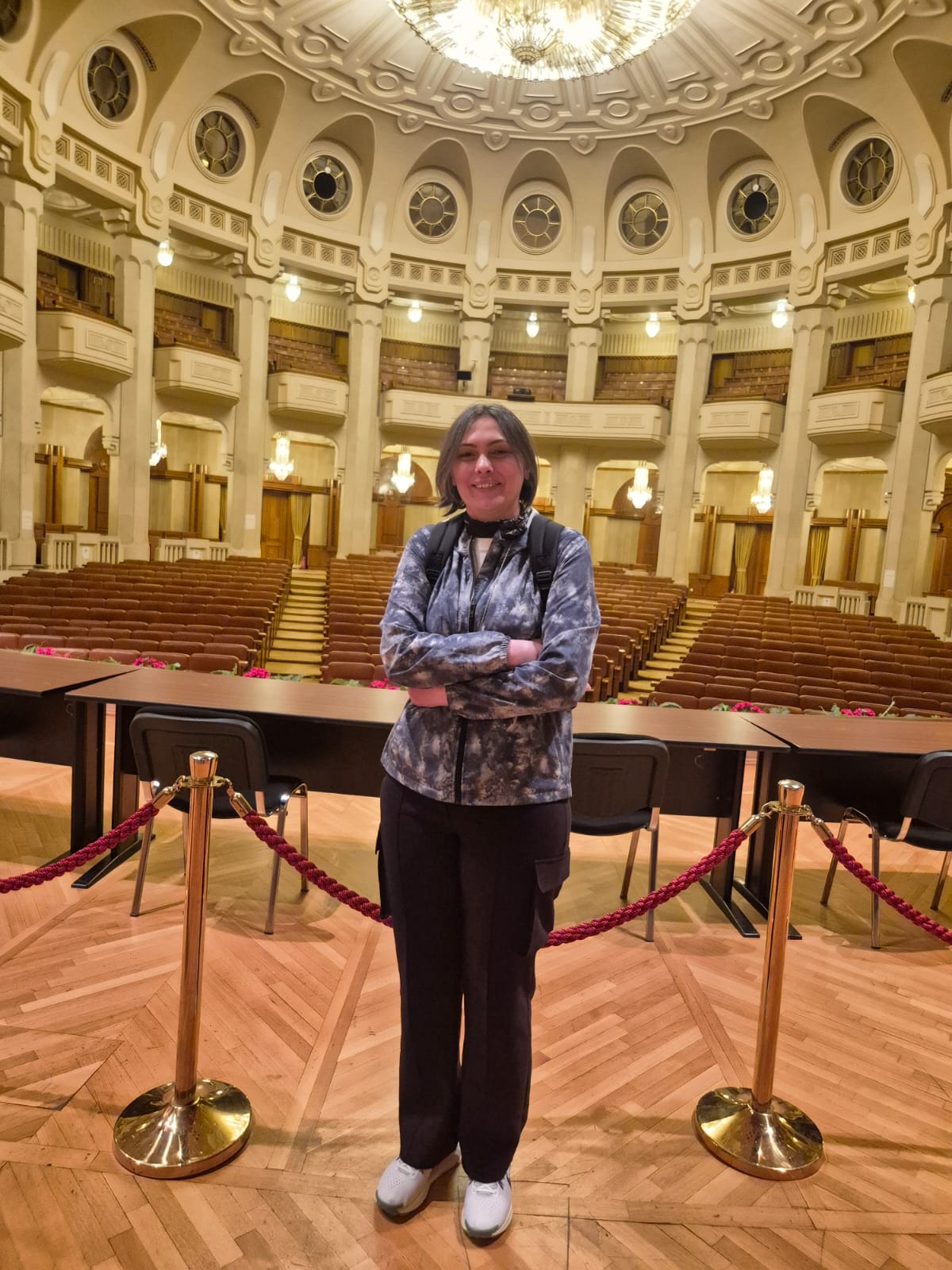
1. Could you introduce yourself and tell us about the school where you teach in Turkey?
-Hello, my name is Dilek Erdağ Bek, and I am an English teacher at Edirne Social Sciences High School in Edirne, Türkiye. I have been an English teacher since 2003 and I’ve been working at my school for one year. As it can be understood from the name of our school, our school focuses on social sciences. Our students are high school students aged 14 and 18. Our school aims to become a modern educational institution that is among the most preferred schools in the coming years by adhering to the scientific principles of educational management, continuously evaluating and improving itself, making the most effective use of its internal dynamics, meeting the requirements of the information age, identifying the social, cultural and artistic needs of society and developing the determination and competence to address these needs, educating well-equipped students capable of shaping the future, and striving to progress from local values to universal perspectives.
2. What motivated you to participate in the “Romania–Turkey Educational and Cultural Bridge: A Dialogue Between Generations” exchange program?
– Education is the most effective way of building bridges between countries and cultures. International projects are one of the best methods of providing various opportunities for learning and personal development. When I started this project, there had been a proposal for such a project existed, but no concrete work had been carried out yet. I wanted to give our students the opportunity to learn from another educational system, discover a different culture and build meaningful relationships with their Romanian partners. I was also excited to exchange ideas with my fellow teachers in Romania.
3. What were your first impressions of Romania and our school?
-At Carmen Sylva Theoretical High School, we were greeted with flowers by students of different ages. Although both countries are home to very different cultures, and despite their distinct characteristics, we felt right at home. We were welcomed with bread and salt, one of your traditions, and you embraced us with a universal perspective.
4. What similarities have you noticed between the Romanian and Turkish education systems?
-To begin with, the division of education by level and age is the same in both education systems. Students go to high schools and universities according to their national exam results. The age of primary school entry is 6 in both countries and also compulsory education begins at that age. There are different types of high schools with different programmes. I have also noticed that schools in both countries value cultural activities, teamwork and the development of students’ social skills.
5. What differences in teaching methods or classroom culture have stood out to you?
-Every school has its own approach to teaching, influenced by its curriculum, resources and classroom culture. Classes are made up of smaller groups. Although the classroom environment is similar in some respects, it is a fact that small groups also influence the classroom environment and teaching methods.
6. How do students in Turkey typically interact with their teachers compared to students in Romania?
-Although in Turkey teacher-student relationships are more formal, I would say that they are good and based on mutual respect in both countries.
7. What aspects of Turkish culture would you most like Romanian students to learn about?
-I would very much like Romanian students to discover the richness and diversity of Turkish culture, from our traditional music, folk dances, and cuisine to our literature, history, and hospitality. Edirne, in particular, has a fascinating cultural heritage and a rich historical past and monuments, thanks to the various cultures that have lived there. I would also like them to learn about Turkish traditions such as hospitality, sharing meals and celebrating special occasions with family and friends.
8. Have you discovered any Romanian traditions, customs, or cultural practices that you found particularly interesting?
– We had the chance to learn about Romanian culture through dance and music performances by students of various age groups. We had the opportunity to meet different people through events held at the museum, at school and outside school. As I mentioned earlier, your tradition of welcoming us with bread and salt, symbol of abundance and prosperity, is particularly remarkable. The soap flowers and traditional shirt, examples of the handicrafts you gave us as gifts, are a reflection of your hospitality. The most memorable feeling that we experienced about your culture is your welcoming attitude.
9. How can educational exchanges like this one help strengthen the relationship between Romania and Turkey?
-Educational exchanges create opportunities for people to meet, communicate and understand one another beyond stereotypes and assumptions. When students and teachers work together, share experiences and discover each other’s cultures, they build relationships based on trust and mutual respect. These connections can develop into long-term partnerships involving joint projects, cultural activities and academic cooperation. I believe that such programmes contribute not only to stronger relations between our schools but also to a more peaceful and understanding future for both countries. Teachers and students will always know that they each have a home in another country, without any prejudices.
10. What challenges and opportunities do teachers face when working in an international educational environment?
– One of the main challenges is communicating across language barriers and adapting to different educational practices and cultural expectations. Planning international activities also requires time, organisation and cooperation. However, these challenges bring valuable opportunities. Teachers can exchange ideas, improve their communication skills, discover new teaching methods and gain a broader perspective on education. Sharing good educational practices, learning about diverse educational models, enhancing cultural competency, cultural awareness, language skills are some other advantages of an international educational environment.
11. What role do young people play in promoting intercultural dialogue and understanding?
– Young people play an important role because they are open to new ideas, curious about the world and increasingly connected through technology. Thanks to their sense of empathy and openness, they are more at the forefront when it comes to being global citizens than previous generations. This means that young people play a major role in ensuring that peace and tolerance prevail in the world.
12.Can you share a memorable experience from your visit to Carmen Sylva Theoretical High School?
– In international projects, an environment is created where, alongside a common language, native languages are also spoken. While speaking Turkish with my friends, I was also communicating in English with my students and colleagues in Romania. From time to time, we would get confused about which language we were speaking with whom. English, Turkish, Romanian… One day, I accidentally spoke Turkish to my Romanian colleagues instead of English. When they looked at me with blank expressions, I realised what I’d done. We’ve all experienced similar moments at different times. Moments we laughed off. Moments when languages and cultures blend together to form a whole. When I think about all these moments, I believe that no difference can prevent us from coming together and standing side by side.
What makes this experience special is the feeling that we are not simply visiting another school but becoming part of a wider educational community. I believe the friendships formed during this programme will remain one of its most valuable outcomes.
13. What advice would you give to students who are interested in studying, traveling, or participating in exchange programs abroad?
– Don’t let your worries hold you back; let your curiosity take you to new horizons. Every new experience helps you grow. Travelling is not only about visiting new places; it is also about discovering different ways of thinking and learning more about yourself. Give yourself a chance and take part in international projects. Take a step forward and start developing yourself by diving into new cultures, languages and worlds, and set out on the path to become a global citizen.
14. In your opinion, what skills are most important for students to develop in an increasingly interconnected world?
– I believe that communication, critical thinking, creativity, collaboration and digital literacy are essential skills for today’s students. It is also important for them to be individuals who are keen to learn, able to respect differences, interested in foreign languages, highly empathetic, and capable of applying academic knowledge in everyday life.
15. What message would you like to leave for the students and teachers of Carmen Sylva Theoretical High School?
– This project brought us together regardless of nationality or language. I have endless faith that the friendship formed between the two countries and the two schools through this project will extend into the future. I believe that, through various projects, we will be able to build on this collaboration with new initiatives that will benefit us as teachers, our students and our schools. I would like to thank all the students, teachers, parents and school administrators at Carmen Sylva Theoretical High School for their hospitality, kindness and willingness to build a meaningful partnership with us.


