Autor: Drăghici Maria, clasa a XI-a C
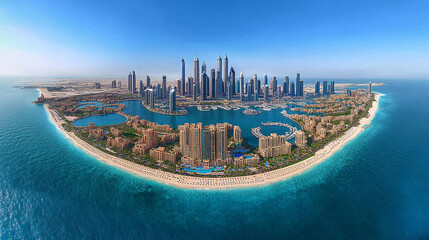
Sursă imagine: https://stock.adobe.com/ro/search?k=palm+island+dubai
There once was a sheikh with big dreams. His land was a sleepy village occupied by pearl divers, fishermen and traders. A small river ran through the village to the sea and it was here that Sheikh Rashid bin Saeed al Maktoum imagined building a gateway to the world. But he could not afford to make his dream a reality. So in 1959 he asked a neighbour to lend him many millions of dollars. He made the river wider, built roads, schools and homes. He built it and the people came.
Then it was his son’s turn to carry on developing his father’s vision. Sheikh Mohammed bin Rashid al Maktoum transformed Dubai into an air-conditioned fantasy world of nearly three million people. No project seemed to be too ambitious for him. He built the world’s tallest high-rise building ( the 828-metre Burj Khalifa), the world’s biggest shopping mall and the world’s largest motorway intersection. He helped little Dubai become the shopping capital of the Middle East.
Dubai attracts more than three million tourists a year. Some of whom have second homes there. Its most famous landmark, the Palm Jumeirah, an artificial island built in the shape of a palm tree, provides holiday villas for the rich and famous. The financial crisis of 2008 made people feel nervous about investing because they risked losing money. So, for a few years, Dubai failed to sell many of its new luxury apartments. But more recently, property in Dubai has been increasing in value again and it has been easier to get people to invest.
The rest of the world watches with a mixture of wonder and suspicion. Is this a model that people want to copy? Or do they feel that Dubai has chosen to reject its heritage and instead become the Las Vegas of the Middle East?